



Research
Research
CIC bioGUNE is a leading research center in the life sciences, with a strong focus on Chemistry, Biochemistry, and Biomedicine, and a particular emphasis on Cellular and Molecular Biology. The center is committed to pioneering multidisciplinary research at the intersection of Chemistry, Mathematics, Biology, and Biomedicine, with the overarching objective of advancing Precision Medicine through the exploration of the molecular mechanisms underlying disease.
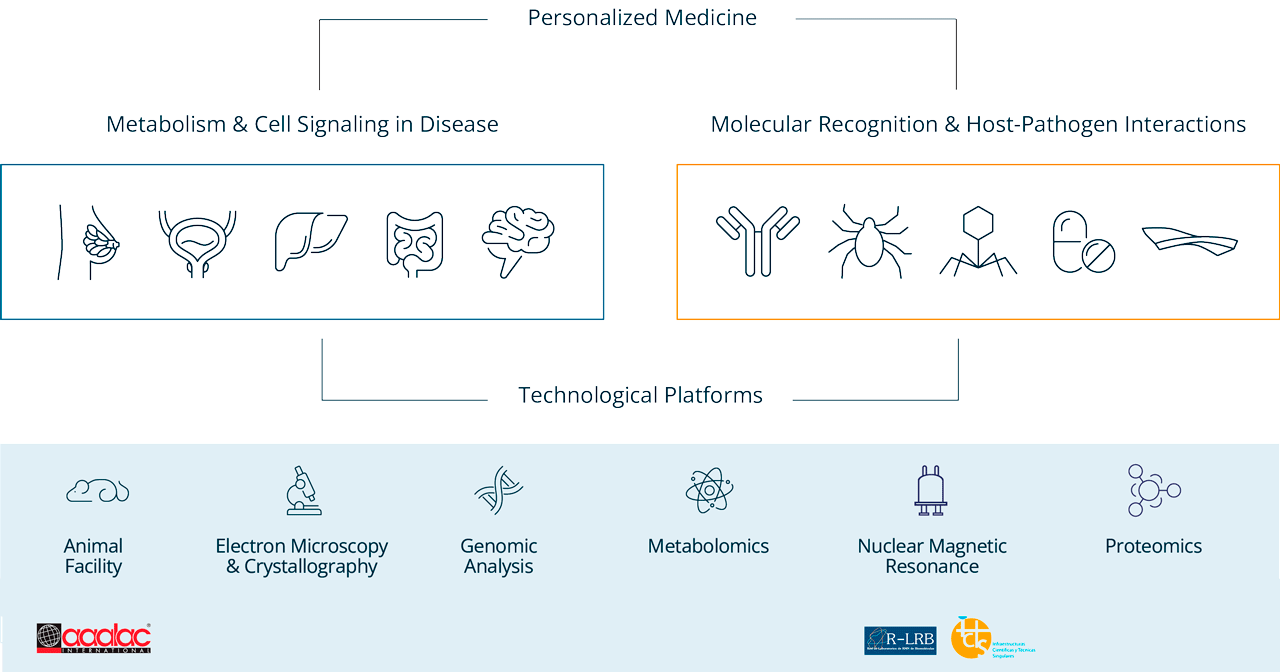
Our scientific activity is organized into two major research programs: "Metabolism and Cell Signaling in Disease" and "Molecular Recognition and Host-Pathogen Interactions." These programs address key biomedical challenges including Cancer, Metabolic Disorders, Rare Diseases, and Infectious Diseases.
Guided by a collaborative philosophy, CIC bioGUNE fosters dynamic multidisciplinary research initiatives with internal teams and a wide network of national and international collaborators. This includes partnerships with academic institutions, clinical centers, research and technology organizations, and stakeholders across the vibrant biotech and pharmaceutical ecosystem.
Our mission is to deliver excellent, internationally competitive research, a commitment recognized by the award of nine European Research Council (ERC) grants. We are equally dedicated to ensuring that the knowledge and technologies generated at CIC bioGUNE translate into tangible societal impact, through active industrial collaborations and partnerships that drive innovation.
Our research is supported by state-of-the-art infrastructures and technology platforms that position CIC bioGUNE among the top-tier research institutions in Europe. These include advanced facilities for nuclear magnetic resonance (recognized as a Singular Scientific and Technical Infrastructure – ICTS), electron microscopy and X-ray diffraction, along with core platforms for genomics, proteomics, and metabolomics.
CIC bioGUNE’s scientific excellence is affirmed by multiple prestigious distinctions, including three National Prizes for Science, the Severo Ochoa Centre of Excellence accreditation by the Spanish Ministry of Science and Innovation, and recognition from the Spanish Association Against Cancer (AECC) for our contributions to cancer research.