


2026/02/05
Researchers uncover how oral epithelial cells change their metabolism to fight the fungus Candida albicans
An international research team, including the Inflammation and Macrophage Plasticity Laboratory at CIC bioGUNE, led by Professor Ikerbasque Juan Anguita, has identified metabolic changes in oral cells during infection by Candida albicans. This discovery opens new possibilities for developing more effective antifungal therapies.
Oral candidiasis is a common infection caused by Candida albicans, primarily affecting people with weakened immune systems, such as those living with HIV, older adults, or individuals undergoing immunosuppressive treatments. Although generally considered a superficial infection, it can cause inflammation and serious complications if not properly treated.
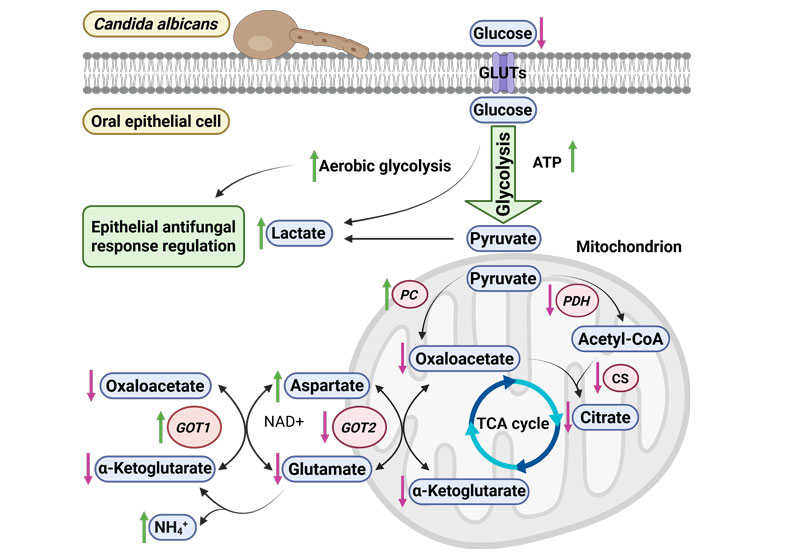
The recent study, published in Science Advances, shows that oral epithelial cells not only detect the presence of the fungus but also reorganize their metabolism in a significant way. In particular, they increase glycolysis, a process in which glucose is rapidly converted into energy, while decreasing the activity of the TCA cycle, the cell’s “powerhouse” in the mitochondria. This shift, known as the Warburg effect, allows a rapid response to infection, although it reduces energy efficiency and affects mitochondrial function.
The team also identified a novel mechanism mediated by the enzyme GOT1, which converts pyruvate into aspartate and ammonia. These molecules regulate the production of proinflammatory cytokines, messenger molecules that activate the immune response, and help C. albicans evade the body’s defenses. The fungus also competes with cells and macrophages for available glucose, which can limit energy for immune cells and weaken the overall response. Finally, this work shows that alterations in the nutritional microenvironment modulate antifungal immune responses of the oral epithelium, opening new ways to improve oral candidiasis treatments.
Together, these findings reveal that the interaction between cellular metabolism and immune response is more complex than previously thought, and that the metabolic environment directly influences the body’s ability to control Candida albicans infection. Understanding how oral cells modify their metabolism opens new opportunities to strengthen immune defenses, reduce inflammation, and develop more precise drugs —such as those targeting GOT1—, complementing existing antifungal treatments and paving the way for innovative clinical strategies.
Reference: Aize Pellon, Shervin Dokht Sadeghi Nasab, Gholamreza Bidkhori, James S. Griffiths, Stefania Vaga, Neelu Begum, Mariana Blagojevic, Nitesh Kumar Sigh, Natalia K. Kotowicz, Ifeanyi Uzochukwu, Adrien Le Guennec, Rhonda Henley-Smith, Harry Gregson-Williams, Frederick Clasen, Miranda Pryce, Nadia Karimpour, Richard Cook, Juan Anguita, Jonathan P. Richardson, Selvam Thavaraj, Julian R. Naglik, Saeed Shoaie, David L. Moyes. Fungal infection drives metabolic reprogramming in epithelial cells via aerobic glycolysis and an alternative TCA cycle shunt. Science Advances. DOI: 10.1126/sciadv.aea0405
About CIC bioGUNE
The Centre for Cooperative Research in Biosciences (CIC bioGUNE), member of the Basque Research & Technology Alliance (BRTA), located in the Bizkaia Technology Park, is a biomedical research organisation conducting cutting-edge research at the interface between structural, molecular and cell biology, with a particular focus on generating knowledge on the molecular bases of disease, for use in the development of new diagnostic methods and advanced therapies.
About Ikerbasque
Ikerbasque —Basque Foundation for Science— is the result of an initiative of the Department of Education of the Basque Government that aims to reinforce the commitment to scientific research by attracting, recovering and consolidating excellent researchers from all over the world. Currently, it is a consolidated organization that has 290 researchers/s, who develop their work in all fields of knowledge.
About BRTA
BRTA is an alliance of 4 collaborative research centres (CIC bioGUNE, CIC nanoGUNE, CIC biomaGUNE y CIC energiGUNE) and 13 technology centres (Azterlan, Azti, Ceit, Cidetec, Gaiker, Ideko, Ikerlan, Leartiker, Lortek, Neiker, Tecnalia, Tekniker y Vicomtech) with the main objective of developing advanced technological solutions for the Basque corporate fabric.
With the support of the Basque Government, the SPRI Group and the Provincial Councils of the three territories, the alliance seeks to promote collaboration between the research centres, strengthen the conditions to generate and transfer knowledge to companies, contributing to their competitiveness and outspreading the Basque scientific-technological capacity abroad.
BRTA has a workforce of 3,500 professionals, executes 22 % of the Basque Country's R&D investment, registers an annual turnover of more than 300 million euros and generates 100 European and international patents per year.
See a large version of the first picture